Showing posts with label digital divide. Show all posts

Saturday, May 11, 2024

Mobile Technology and Libraries


Almost everyone has a mobile device from children to older adults and libraries have had about 20 years in the mobile technology game. Technology is always evolving, and libraries need to keep their mobile knowledge up to par. With a smartphone screen different from a PC’s, layouts need to be modified and “more suitable for the smartphone” (Bohyun). Having accessible top search links on the home screen of mobile sites creates easier accessibility. Some of those would be hours & location, catalog, My account, and collections. Users can also use features to reserve a study room or a computer at their library using mobile technology. I can say I've used my device to check the library hours and renew a book.

Students at Kent State University had suggestions for their mobile library website such as catalog searches, placing holds, receiving text when items are available and reminders for due dates, customizing databases (favorites), and live chat with the librarian (Bohyun). I agree, that accessing the mobile online library catalog and placing a book on hold is very convenient, especially when you're waiting at the DMV or other places that take lots of your time. 

Mobile technology also has built-in accessibility features to help users with visual impairment such as screen filters, color invert, digital magnification, and voice-over features (Biersdorer). 


Bohyun Kim. “The Present and Future of the Library Mobile Experience.” Library Technology Reports, vol. 49, no. 6, Aug. 2013, pp. 15–28. EBSCOhost, search.ebscohost.com/login.aspx?direct=true&db=f6h&AN=90405355&site=ehost-live&scope=site.

BIERSDORFER, J. D. "The Built-In Accessibility Features of iOS." New York Times (Online)New York Times Company, 2016. ProQuest, login.ezproxy.palomar.edu/login?auth=shibboleth&url=https://www.proquest.com/blogs-podcasts-websites/built-accessibility-features-ios/docview/1845285258/se-2.

Assistive Technology and Libraries

(Assistive Technology)


Libraries are places where individuals from all ages and walks of life can seek information on almost anything using physical resources, online resources, and information given during library programming. One way libraries are continuously creating ways to bridge the digital divide is by providing assistive technologies per the Americans with Disabilities Act (ADA) making libraries more accessible to individuals with disabilities (Hopkins).


Having assistive tools in the library helps a partially or completely blind person use assistive technology by sound or text-to-speech on a computer to access the internet also, a person with mobility issues might use devices like scanning software, large or small keyboards, and trackballs (Mates). These technologies in the library are a gem to individuals who benefit from their use and help make life a little easier.
I found it fascinating that Andrew Heiskell Braille and Talking Book Library held an event in 2017 during an eclipse, providing visitors “visually impaired” to hear and feel the eclipse using verbal descriptions and vibrations (Alfaro) This was one way the library created inclusivity thanks to the knowledge of staff and Nasa who created the app. Libraries can seek help from organizations to support implementing a more inclusive library. You can find some of the links to these organizations on the side bar of this blog.

Works Cited

Alfaro, Mariana. "Events Across New York Will Offer Ways to Watch the Eclipse; Even those who did little planning will be able to catch the astronomical phenomenon at a library--or bar." Wall Street Journal (Online), Aug 19, 2017. ProQuest, https://login.ezproxy.palomar.edu/login?auth=shibboleth&url=https://www.proquest.com/newspapers/events-across-new-york-will-offer-ways-watch/docview/1930092848/se-2.
Hopkins, Janet. “Assistive Technology for the School Library.” Library Media Connection, vol. 21, no. 6, Mar. 2003, p. 46. EBSCOhost, search.ebscohost.com/login.aspx?direct=true&db=f6h&AN=9351367&site=ehost-live&scope=site.

Mates, Barbara T., and Char Booth. “Information Power to All Patrons.” Library Technology Reports, vol. 48, no. 7, Oct. 2012, pp. 7–13. EBSCOhost, search.ebscohost.com/login.aspx?direct=true&db=a9h&AN=83242900&site=ehost-live&scope=site.

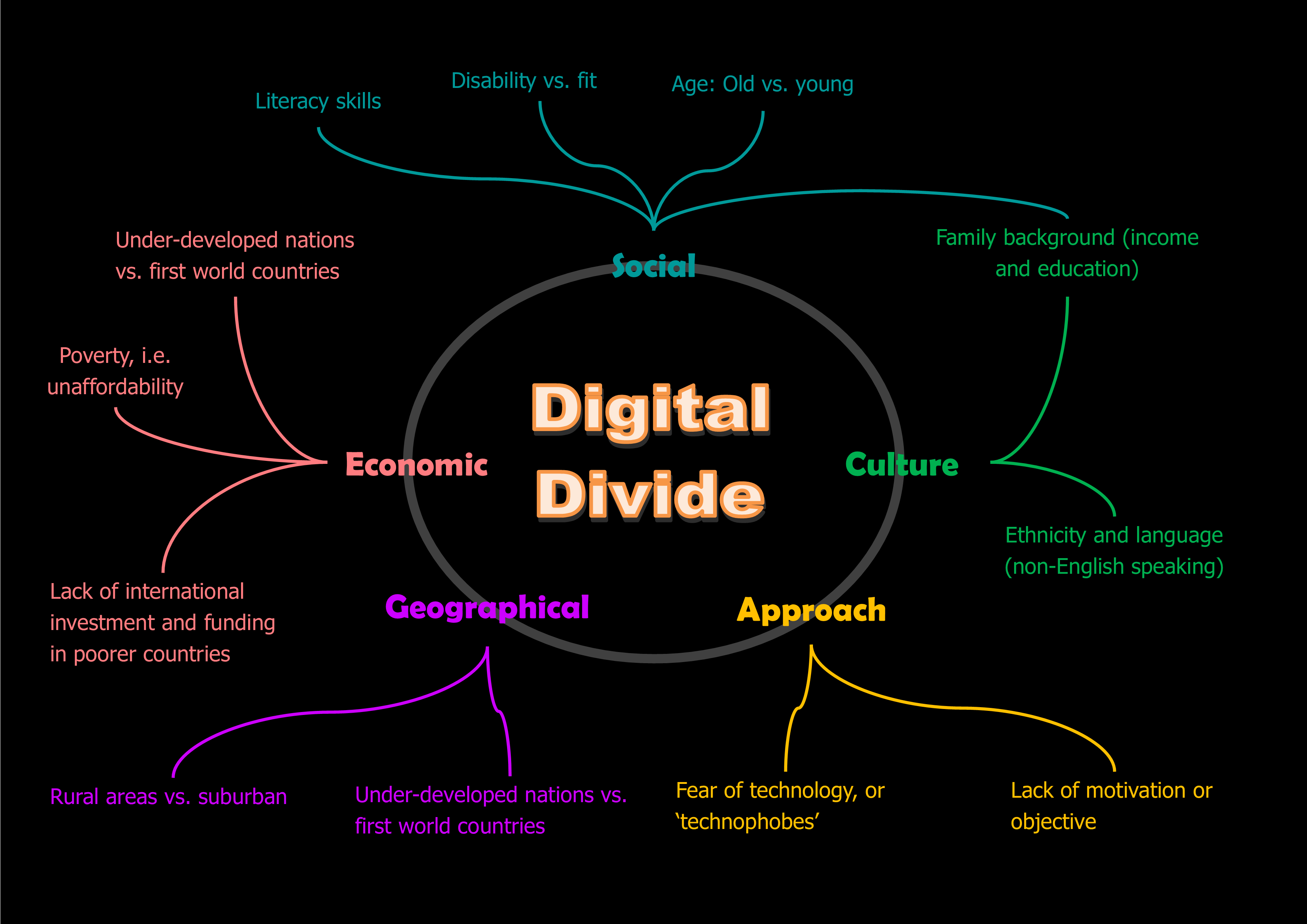
Libraries and the Digital Divide

(Reynolds)

Bridging the gap in the digital divide is an essential task that libraries undertake. Library users ranging from ages 0-80+ years old and socio-economic ranges that span just as wide, libraries must make it an objective to serve all. How do they do that, a lot of work that’s how. Libraries provide computer access, wireless internet access, laptops, and some libraries even have tablets to borrow.  In some libraries, users check out mobile hotspots because they do not have internet access at home (Lee King).

Individuals with disabilities face challenges in social, economic, and educational settings and as “Baby Boomers” age they become susceptible to diseases that affect eyesight, joints, and cognitive functions, and numbers in this group are predicted to increase 100% by 2030 (Mates).  Libraries are digitally inclusive places, with access to digital resources, support, and skills providing users with the latest technologies at no cost. Users who may not have had access previously can benefit from their public library.

By: Estela Perez

Works Cited
Lee King, David. “Chapter 4: The Digital Divide.” Library Technology Reports, vol. 57, no. 2, Feb. 2021, pp. 24–28. EBSCOhost, search.ebscohost.com/login.aspx?direct=true&db=f6h&AN=148951874&site=ehost-live&scope=site.

Mates, Barbara T., and Char Booth. “Information Power to All Patrons.” Library Technology Reports, vol. 48, no. 7, Oct. 2012, pp. 7–13. EBSCOhost, search.ebscohost.com/login.aspx?direct=true&db=a9h&AN=83242900&site=ehost-live&scope=site.

Reynolds, Dennis. “Digital Divide Part 2” Dennis Reynolds, 29 Jan. 2016, PennStatesites.psu.edu/dennisreynolds/2016/01/29/digital-divide-part-2/.  Accessed 11 May 2024

Gadget-Adding a List Gadget

On this blog, I chose to add a list gadget to the right side of the page. It provides links to organizations that can assist libraries in pr...